Guides
Starting a deck and patio business without guessing at the market
A deck and patio crew sells built work, not plans. Price the spring build season, the permit queue and the callback before you hire your first carpenter.
What to take away
- A deck and patio business is a build business. You sell a finished structure, so price the build before you price the marketing.
- Market research starts with free public data. Pull permit counts from your city, owner-occupied rates from the Census Bureau, and carpenter wages from the Bureau of Labor Statistics.
- Fall protection on residential work is an OSHA matter, and the employer carries the duty. Read the guidance and confirm your state plan.
- Register the business with the SBA's planning steps and the IRS structure and recordkeeping steps before the first invoice.
- License, insure and file the EIN before the first estimate, not after.
- A permit delay in the busiest month is a cash problem, not a scheduling problem. Hold a buffer sized to your own queue.
This article covers general contracting practice for deck and patio work. It is not structural, engineering or legal advice.
Footing depth, beam spans, guardrail loads and ledger attachment are set by the applicable building code and confirmed by a licensed structural engineer or the local authority having jurisdiction.
Licensing, permits, tax and employment requirements vary by state and municipality, so confirm them with the relevant regulator.
License, permits and the launch sequence
Do I need a license to build decks?
It depends on your state and municipality. Many jurisdictions license general or residential contractors, and some require a separate trade license for the work itself. California's CSLB, for example, requires a contractor license for any job over $500 in labor and materials. Confirm with your state licensing board and the municipal building department before you advertise.
A building permit is a separate step from licensing. A residential deck permit typically runs $100 to $500, based on project valuation, and the building department issues it on its own calendar.
Register in this order, before you bid a job:
Do I need a license
- Form the LLC with your state.
- Get an EIN from the IRS. It is free and issued online the same day.
- Apply for the contractor license your state requires for the work you sell.
- Buy general liability insurance and confirm the workers compensation rules before your first hire.
- Write the first estimate from your own job cost sheet, with the permit and inspection stages as line items.
Build sequence
Most new deck and patio owners spend their first month on a logo and a website. The work that decides whether the business survives happens on the framing day.

A deck fails in predictable places. Rot starts behind the ledger board when flashing is wrong. Frost heave lifts a footing poured above the local frost line. A guardrail that was never engineered for its load moves under a hand. Each one comes back as a callback on your own dime.
So learn the sequence before you sell it. Foundation and footings. Framing. Decking. Railing. Inspection. Punch list. Payment. Warranty follow-up. You do not have to pour the first footing yourself, but you have to know which stage is holding the job.
The authority for every number in that sequence is the building code, not a supplier's brochure. Where the code is silent or the site is unusual, a licensed structural engineer signs off. That is the honest answer, and it is also the answer that keeps you insurable.
Startup costs
Startup costs for a two-person crew typically land between $10,000 and $30,000, not counting a truck. A used pickup costs $15,000 to $30,000, and an enclosed trailer $3,000 to $8,000. Framing tools, a miter saw, a compressor and fall-protection gear add $2,000 to $4,000.
The tool list to own before the first build: a circular saw, a framing nailer, a miter saw, a compressor, a laser level and a string line, a post-hole digger, fall-protection harnesses with anchors, staging planks, and spare batteries. Rent the excavator and the concrete pump by the job.
State LLC filing fees run $50 to $500. A general contractor license costs $200 to $700 in many states; California's CSLB application fee is $450. General liability insurance for a small deck crew typically runs $1,000 to $3,000 per year.
Crew: hiring and subcontracting
Subcontract the footing pour, the concrete flatwork and any electrical work first. Those trades carry their own tools, and their warranty runs to their own work. Ask for a license number and a certificate of insurance before they start.
Hire your first employee when signed work consistently exceeds what you and a helper can finish inside your booking window. Payroll taxes and workers compensation start on day one, so price that hire into the next job, not the last one.
Deck and patio pricing
Price the build from your own numbers. In most U.S. markets as of 2026, a pressure-treated wood deck installed runs about $15 to $25 per square foot. Composite decks run $25 to $45, and PVC decks $30 to $50.
Concrete patios run $6 to $12 per square foot, pavers $10 to $25, and natural stone $20 to $40. Those ranges move with site access, railing choice, stairs and local labor.
Those ranges are a cross-check, not a method. Build each estimate from four buckets: material with an 8 to 10 percent waste factor, direct labor hours at a burdened rate, equipment and disposal, and a permit allowance.
Then load overhead and margin. Overhead is the share of truck, insurance, phone, storage and unbilled time that each job must carry. Margin is profit. A common rule is to divide total direct cost by one minus the overhead and profit percentage. At 20 percent combined, divide by 0.8.
Track estimated hours against actual hours on every job. The divisor only holds if the hours are real.
Jobber's entry plan starts around $29 per month, and QuickBooks Online Simple Start around $30 per month. Both track estimates, change orders and job costs.
Public sources: SBA, IRS and OSHA
Three public sources cover the ground a new owner needs first. The U.S. Small Business Administration: [SBA Business Guide covers planning, launch, management, and growth. It includes market research, startup costs, permits, and insurance. Work through it before you commit to a shop lease or a second truck.
The Internal Revenue Service: Starting a business covers structure, tax identification and recordkeeping. Choose the structure and start the records in month one, not at year end.
The Occupational Safety and Health Administration: Fall Protection in Residential Construction describes fall-protection methods for residential work. The employer carries the duty, and state-plan states may add to the federal rule. Confirm your state's requirements with the OHS regulator that covers you.
Market research with public data
Market research does not need a consultant. Work through these sources once, then update them each quarter:
- Demographics. The Census Bureau's American Community Survey gives owner-occupied rates, median household income and median home value for your county or ZIP. High owner-occupied rates and incomes above the metro median support deck demand.
- Mapping. The Census Business Builder maps business and demographic data by area.
- Wages. The Bureau of Labor Statistics Occupational Employment and Wage Statistics reports carpenter wages by metro, which sets your labor floor.
- Permits. Permit counts are public. Open your city's open data portal or building department site and export the permit list. Chicago, Austin and Seattle publish building permit data online. Sort last year's deck and patio permits by month to see the spring spike and the review queue.
- Demand timing. Add Google Trends for "deck builder near me" to confirm when searches peak in your market.
- Competitors. Competitor research is simple. Check Angi, Houzz, Thumbtack and Google Business Profile for the builders who already rank in your ZIP. Note their advertised price ranges, response times and review counts. Ask three local builders for a written bid on the same hypothetical 16 by 20 composite deck. That gives you a market price without guessing.
Lead generation
Google Business Profile is free and often the first lead source for deck builders. Claim the profile, verify the address, set the category to deck builder, and list the ZIPs you serve. Add photos of every finished job and ask for a review at the final walkthrough.
The referral ask is one sentence at punch list. Something like: "Thanks for the final walkthrough. If you were happy with the work, a Google review helps, and one name from you is worth more than any ad."
Angi leads typically run $15 to $100 each, and Thumbtack charges per lead by category. Houzz Pro subscriptions typically run $99 to $399 per month.
Permit queue math
The mistake that closes deck companies is not a slow month. It is a spring with more signed contracts than crews.
Permits drive that. A municipal building department reviews drawings on its own calendar, and the queue lengthens exactly when every homeowner in the city wants a deck. Your busiest sales month and your slowest permit month are the same month.
Size the buffer with your own figures:
- Let P be the average permit turnaround in weeks, measured from your last ten jobs.
- Let W be the weeks of work you can hold in signed contracts without running out of crew.
- Your booking window is W minus P. If that number is negative, stop selling and start hiring or subcontracting.
That arithmetic is yours to fill in.
In many cities, a simple deck permit takes two to six weeks, and longer in April and May.
Worked example: two-person crew, first spring
A two-person deck and patio contractor starts with framing tools, a municipal building department license, and more confidence in the carpentry than in the pricing.
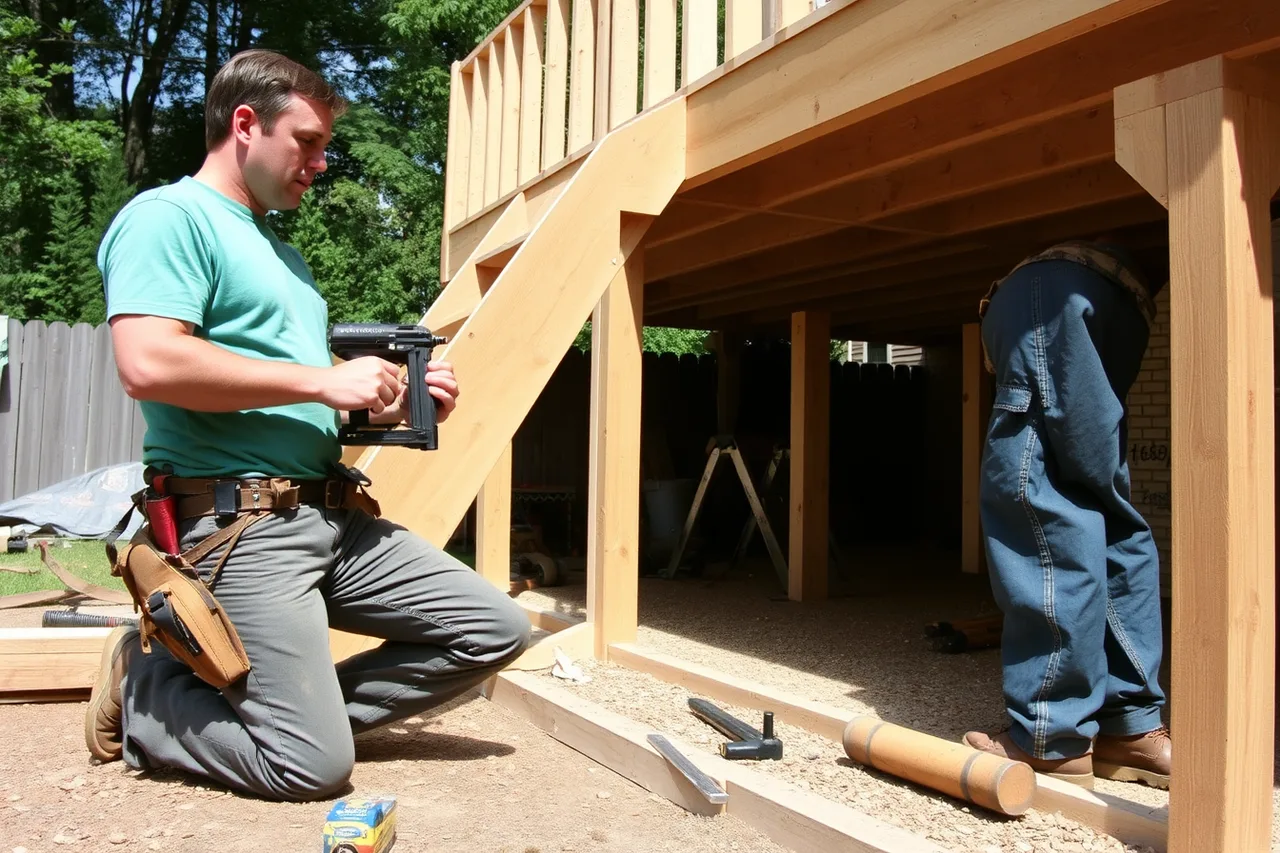
Finished-project signage and photos bring the first homeowner. That build teaches more about scope than any plan did. The homeowner adds a pergola mid-job, the railing spec changes, and the crew learns what a change order is for.
Then the arithmetic. One 16 by 20 composite deck is 320 square feet, which at the typical $25 to $45 per square foot installed is $8,000 to $14,400 of revenue on the books.
Break-even for the first spring is the cost of the weeks spent waiting on the permit. Two carpenters at a metro median of $25 an hour, 40 hours a week for four weeks, is $8,000 in wages before payroll burden, plus truck, insurance and storage.
Substitute your metro's BLS carpenter wage for that $25 and the break-even moves with it.
Common questions
How do I price a deck job?
Price from your own completed jobs, not from a competitor's quote. Track material, labor, equipment, disposal and permit fees for each build. Add a share of overhead. If the last ten jobs do not cover overhead plus a margin you can name, the price is wrong.
Use the typical installed ranges as a check: pressure-treated wood $15 to $25 per square foot, composite $25 to $45, concrete patio $6 to $12, pavers $10 to $25.
What causes most deck callbacks?
Flashing at the ledger board, footings above the frost line, and fasteners that were not rated for the material or the coastal air. Each is a detail fixed at the build stage and expensive to fix later. Follow the code and the manufacturer's instructions for your material.
When should I hire my first employee?
When signed work consistently exceeds what you and a helper can finish in your booking window. Count the permit queue in that window.