Guides
Calgary Deck Patio Design for Hail and Chinooks
Deck patio design in Calgary must account for hail, chinook temperature swings, frost heave, drainage, snow loads and product documentation.
What to take away
- A deck patio in Calgary must handle hail, chinook swings and frost heave, not just look good.
- Design loads come from the National Building Code of Canada and the Alberta Building Code that adopts it, and the building permit comes from the City of Calgary.
- Patio covers need a hail impact rating, usually a Class 3 or Class 4 rating under UL 2218 or FM 4473.
- Decks should use flexible connections and slotted holes so movement does not split lumber or pull fasteners.
- Footings must reach below the frost line, typically 1.2 m to 1.5 m in Calgary, on undisturbed soil or engineered fill.
- Patios need positive drainage and snow load design for the Calgary area, often 1.5 kPa to 2.0 kPa ground snow load.
- Keep every hail rating certificate and warranty document, because claims depend on paper, not memory.
How Calgary hail and chinook cycles stress deck and patio assemblies
Calgary sits in a hail alley that runs along the eastern slopes. Storms can drop golf-ball-sized hail on a patio cover in minutes. The same week, a chinook can push the temperature from minus 20 to plus 10 in a day.
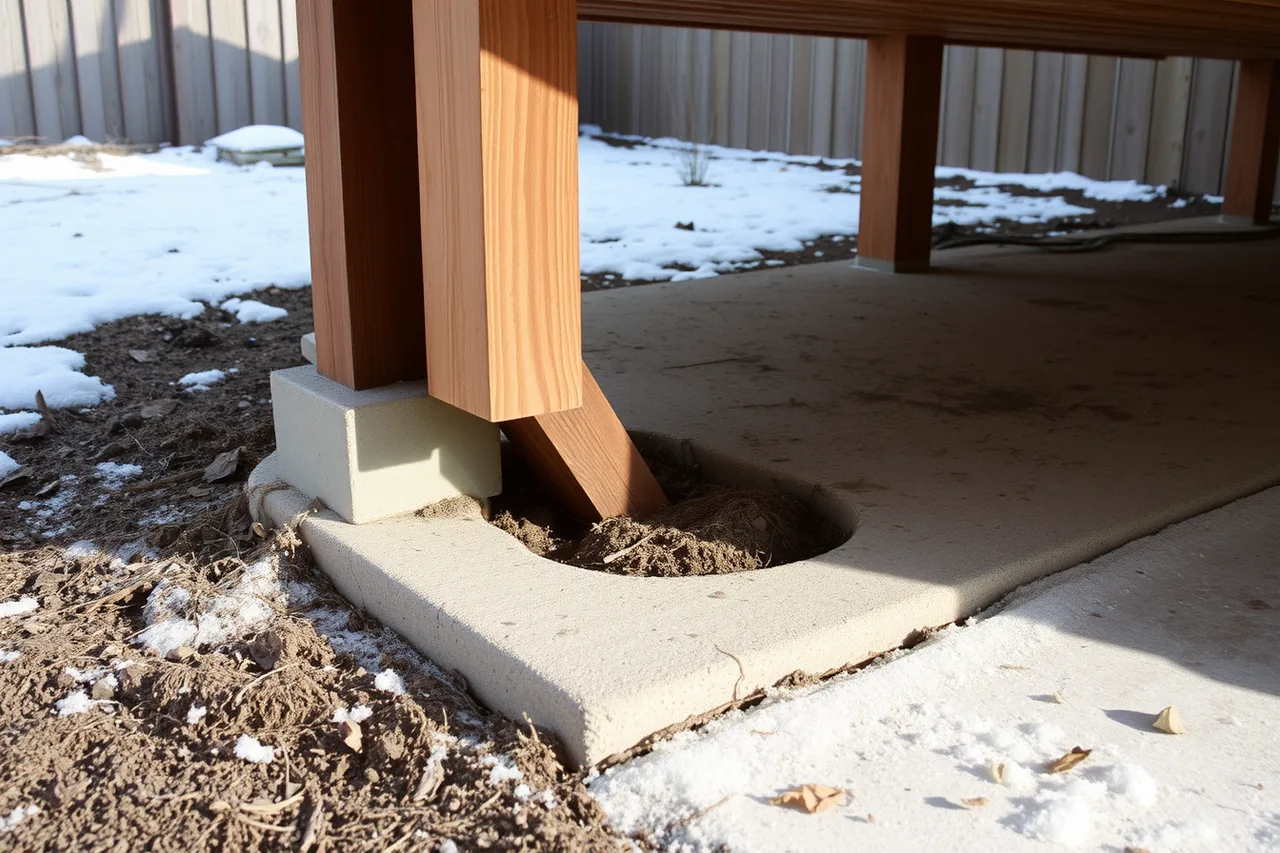
The freeze-thaw cycle is the quiet problem. Water enters a hairline crack in a concrete footing, freezes, expands and widens the crack. Repeat that dozens of times each winter and the footing moves. Frost heaving is the upward movement of soil caused by ice lenses forming in freezing ground, and it can lift a deck post unevenly.
Chinook swings work on the deck frame too. Wood expands and contracts with moisture and temperature. A rigid connection that cannot move will either crush the wood or back out a screw. That is why Calgary deck builders design for movement instead of fighting it.
The market context matters. Housing and construction data for the Calgary region show steady demand for outdoor living space, and homeowners expect that investment to survive a hailstorm. You can review national housing statistics through Statistics Canada to see how renovation spending tracks with new construction.
Impact-resistant materials for patio covers and roof structures
Not all patio cover materials handle hail the same way. The key number is the impact rating. Under UL 2218, a Class 4 rating means a two-inch steel ball dropped from 12 feet does not crack or puncture the panel. Under FM 4473, Class 4 is the top rating for severe hail.
Here is how common cover materials compare.
Impact-resistant materials
| Material | Typical hail rating | Notes for Calgary |
|---|---|---|
| Polycarbonate panels | Class 3 to Class 4 | Best impact resistance; check UV coating |
| Acrylic panels | Class 2 to Class 3 | Can craze over time; less hail tolerant |
| Aluminum standing seam | Class 4 | Dents instead of cracking; repairable |
| Fibreglass panels | Class 2 to Class 3 | Cheaper, but hailstorms shorten life |
| Asphalt shingles | Class 3 to Class 4 | Only if the cover is a full roof structure |
| Cedar shakes | Class 2 to Class 3 | Poor hail performance; high maintenance |
Thickness matters as much as the class. A 10 mm polycarbonate sheet will outperform a 6 mm sheet with the same nominal rating. Ask for the manufacturer's test report, not just a brochure claim.
The frame matters too. A cover rated for hail will still fail if the rafters are undersized for snow. The National Research Council Canada publishes the model code structural provisions — the National Building Code of Canada — and Alberta adopts them through the Alberta Building Code, the document a Calgary reviewer opens. Pull the Calgary snow and climatic values from that code's own data, not from a supplier's brochure.
Deck assemblies that tolerate rapid temperature swings
A Calgary deck moves constantly. The design goal is to let it move without loosening or splitting.
Use diagonal bracing or a continuous ledger connection instead of relying on a few toenails. Toenails back out when lumber shrinks. Structural screws or bolts with washers hold better.
- Set posts on adjustable post bases that allow vertical movement.
- Use joist hangers with slotted or oversized holes where the code allows.
- Leave a 3 mm gap between deck boards for expansion and drainage.
- Fasten boards with hidden clips or screws, not nails.
- Keep the ledger flashing continuous and sloped away from the house.
The decking material choice matters. Composite boards move more with temperature than cedar or pressure-treated pine. That is not a dealbreaker, but it changes the gap size and fastener type. A quality assurance checklist should test these details before the frame is closed in, not after.
Tool and fastener choice is a business decision, not a hobby one. If you are comparing what to standardize across the crew, the deck and patio equipment worth your attention on chinook-country work starts with impact drivers that have torque control for slotted connections and the fastener system that matches the decking you sell.
Footing and connection details for freeze-thaw movement in Calgary
Footings are where freeze-thaw does its worst work. In Calgary, the frost line is deep enough that most deck footings need to reach at least 1.2 m below grade, and many engineers specify 1.5 m. A shallow concrete pier will heave.
The footing must bear on undisturbed soil or compacted engineered fill. Loose backfill under a pier is an invitation to settlement and frost movement.
Use a concrete mix rated for freeze-thaw exposure, and air-entrained concrete where it is available. Air entrainment creates tiny bubbles that give freezing water somewhere to expand without cracking the concrete.
Connections above the footing should allow some movement. A post base that bolts to the concrete and holds the post slightly above the surface keeps the wood dry. Direct wood-to-concrete contact wicks moisture and rots the post bottom.
Frost action is why depth and drainage matter more than concrete strength alone. The Alberta Building Code, which adopts the National Building Code of Canada, requires footings to bear below the depth of frost penetration for the area. In Calgary the working range is the 1.2 m to 1.5 m most engineers specify, and confirming it before the auger moves is the contractor's call, not the homeowner's.
Drainage and snow load considerations for Calgary patios
Calgary patios collect snow from October through April. A flat patio surface with no slope will pond meltwater and refreeze, creating a slippery sheet and a drainage problem.
Slope hard surfaces away from the house at about 2 percent, or 6 mm per 300 mm. That is enough to move water without making the patio uncomfortable to walk on.
Snow load is a structural issue for covered patios. Ground snow load in the Calgary area is commonly in the range of 1.5 kPa to 2.0 kPa, and roof structures must be designed for that plus drift. A patio cover that is fine in July can sag by February if the rafters are undersized.
Drainage details to check:
- Downspouts discharge at least 1.5 m from the footing.
- Patio surface slopes away from the house.
- No low spots where water can pond.
- Weep holes or gaps at the bottom of cover panels.
- Gutters sized for heavy rain and snow melt.
- Swales or French drains where the lot grade falls toward the house.
Get the snow load number from the code, not from a generic table. The National Building Code of Canada's climatic data, adopted in Alberta through the Alberta Building Code, carries the Calgary values a designer has to work from. Calgary's climate data, including chinook temperature swings and freeze-thaw cycles, is available through the Canadian Centre for Climate Services.
Sourcing hail-rated products and documenting warranties
A hail rating is only useful if you can prove it after a storm. That means keeping the paperwork.
Ask suppliers for the UL 2218 or FM 4473 test certificate for the exact panel or shingle you are installing. A certificate for a different thickness or profile does not cover your product.
Warranty documentation should spell out what hail damage is covered. Many warranties exclude cosmetic damage, which is exactly what hail causes. Read the exclusions before you promise a client anything.
Keep a file for every project with the product certificate, the installation manual, the warranty terms and photos of the finished work. When a homeowner files a claim, that file is the difference between a replacement and an argument.
Business insurance for a deck and patio contractor should also be reviewed. General liability may not cover faulty workmanship claims, and hail damage disputes can turn into those quickly.
Contractors can use deck and patio local seo to help Calgary customers find information about their hail-rated cover materials, fastening systems and warranty terms.
What Calgary hail and chinook design asks of the contractor's business
Specifying for hail and freeze-thaw movement shows up in three places: the contract, the schedule and the job file.
- The contract should name the hail class of the cover material and the snow load the frame is designed for, so a later dispute turns on a document instead of a memory.
- The schedule should stage the work around freeze-thawfootings poured and protected before the ground closes, cover panels set only after the frame is braced and the ledger flashing is finished.
- The job file should hold the UL 2218 or FM 4473 certificate for the exact panel installed, the footing note from the engineer, the warranty terms and dated photos of the finished work.